
Property Tax in Illinois Calculator – Accurate & Updated Tax Estimator
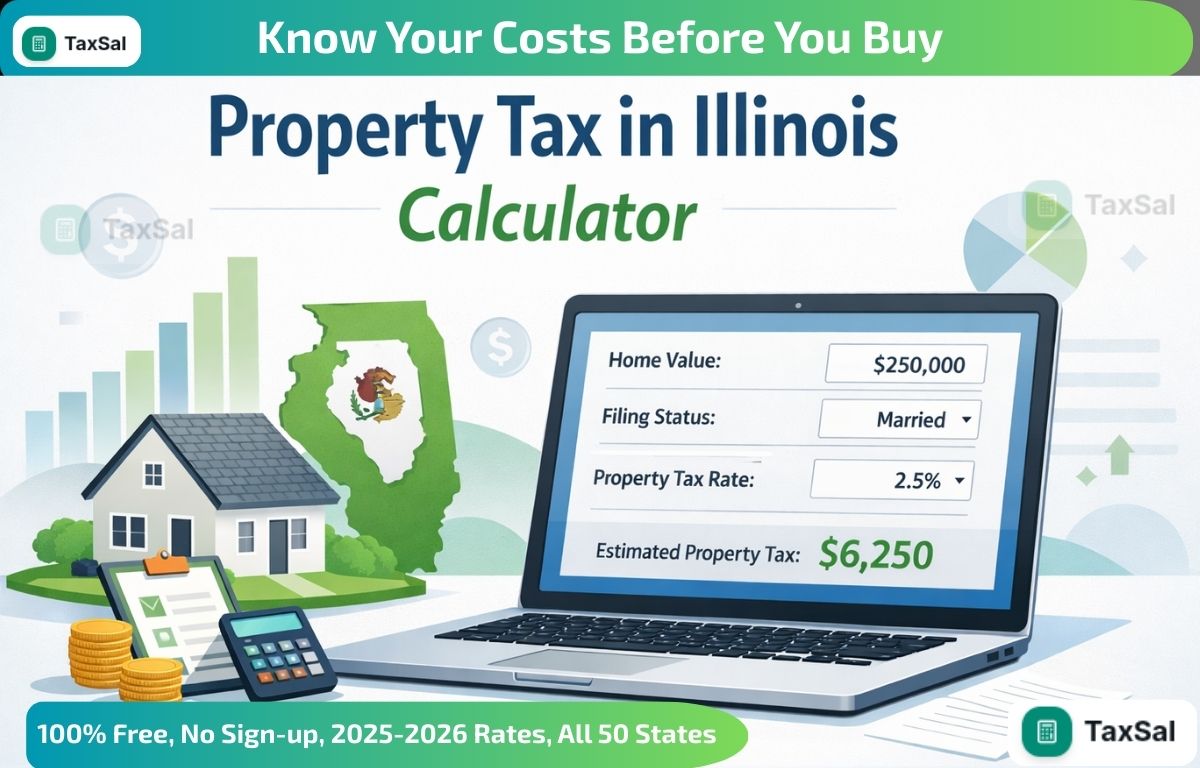
Calculate your annual property taxes quickly with our Property Tax in Illinois Calculator. Get accurate estimates, compare rates, and plan your budget easily.
Property Tax in Illinois Calculator Illinois has the highest statewide effective property tax rate in the nation at 1.92%. This measure reflects the share of a typical home’s value that homeowners pay in property taxes each year. At that level, Illinois’s effective rate is more than twice the national median of 0.89%. Meanwhile, the typical homeowner in Illinois pays $5,399 annually in property taxes. In some areas, this figure can reach well over $7,000 per year.
Part of the reason for the high property taxes in Illinois is that there are over 8,000 different taxing authorities. Property Tax in Illinois Calculator Property taxes in Illinois support city governments, county governments, and school districts, along with a vast number of other local services and projects. Among the types of taxing districts that may appear on your property tax bill in Illinois are fire protection districts, sanitary districts, park districts,s and even mosquito abatement districts.
Check Here: Property Tax in Illinois Calculator 2025-2026
 How Property Taxes in Illinois Work
Property tax assessments in Illinois run on two- to five-year cycles. Property Tax in Illinois Calculator When assessments are done, local officials appraise real estate to determine a market value for each home in their area. The assessed value of property in most of Illinois is equal to 33.33% (one-third) of the market value of the residential property, though it may be different in certain counties. After local officials calculate the assessed values of properties, county boards review these values to determine if they are correct. These county boards may equalize assessed values.
If they find, for example, that the property in a certain district was appraised at half of its actual value, they will apply an equalization factor of 2, doubling the assessed value of everything in the district. Property owners also have the opportunity to protest their assessed value before the county board. If a homeowner is not satisfied with the county board’s decision, they can appeal to the State Property Tax Appeal Board or even the circuit court. The state of Illinois also equalizes values between counties by issuing an equalization factor for each county. This ensures that assessed property values in all counties are comparable.
Property Tax Exemptions in Illinois
There are a number of exemptions that can reduce assessed value (and therefore property tax payments) in Illinois. The most significant is the General Homestead Exemption, which is available to homeowners living in their principal residence. Property Tax in Illinois Calculator The General Homestead Exemption is equal to a $10,000 reduction in assessed value in Cook County, $8,000 to counties contiguous to Cook County, and $6,000 in all other counties.
Another important exemption is the Senior Citizens Homestead Exemption. This exemption is available to homeowners who are 65 years or older and can be applied to their primary residence only. It's equal to a $5,000 reduction in assessed value, except for Cook County and counties contiguous to it, where the reduction is $8,000.
Illinois Property Tax Rates
Specific tax rates in Illinois are determined based on the total tax base, or the total value of property within a district. In the second year of the property tax cycle, each taxing authority determines its levy based on the tax base and the revenue it needs. Thus, rates change each year depending on property values and revenue needs (which are typically subject to voter approval).
Usually, however, changes in rates are minor. Increases in total taxes are limited by the Property Tax Extension Limitation Law (PTELL). This law limits property tax growth that results from rising property values. In this situation, revenues (and therefore tax bills) cannot grow faster than the rate of inflation (change in the Consumer Price Index) or 5%, whichever is lower.
Cook County
Cook County is the largest county in Illinois and is home to more than 40% of the state’s residents. Effective property tax rates in Cook County are actually just below the state mark, with an average rate of 1.89% in the county compared to 1.92% for the state. While Cook County’s assessment level of 10% for residential property is lower than the level in the rest of the state (33.33%), this difference is more or less wiped out by the state equalization factor, which was 3.0355 for 2024 (announced in May 2025). That means assessed values, as initially calculated,d are multiplied by 3.0355 to reach the assessed values to which taxes are applied.
DuPage County
A typical homeowner in DuPage County pays $7,812 each year in property taxes. That is one of the highest property tax bills in the state, but it is reflective of high home values in the county. The median home in DuPage County is worth $409,100, the highest of any Illinois county. In fact, the effective property tax rate (1.91%) in DuPage County is nearly the same as the statewide median.
Lake County
If you are looking for low property taxes in Illinois, Lake County may not be the best choice. The county, which sits to the north of Chicago, has an effective property tax rate of 2.43%. This is also one of the highest rates in the state. However, in absolute terms, Lake County homeowners pay more than anyone else in the state. The median homeowner in Lake County pays a whopping $8,943 in property taxes annually.
Will County
Will County sits to the south of DuPage and Cook counties and is home to one of the largest cities in the state, Joliet. Property taxes in Will County are well above both the state and national medians. The effective property tax rate in the county is 2.12%, more than double the national rate. That means that if you own a $400,000 home in Will County, you can expect to pay around $8,480 a year in property taxes.
Kane County
Kane County has some of the highest property taxes in Illinois. The typical Kane County homeowner pays $7,219 annually in property taxes. While that's nearly $2,000 more than the state median, it's less than neighboring DuPage County, where the median property tax bill is more than $7,812 annually.
McHenry County
McHenry County homeowners pay around 2.18% of the median home value each year in property taxes. The median property tax payment is $7,176, while the median home value is $328,900.
Winnebago County
Located in the north-central part of the state, Winnebago County contains the state’s fifth-largest city, Rockford. At 2.16%, the county’s effective property tax rate is one of the highest in the state. However, a median home value of just $181,300 leads to a typical property tax bill of $3,910.
St. Clair County
St. Clair County levies taxes on real estate to support the county government, as well as cities and schools. The median homeowner in St. Clair County pays $3,572 in property taxes annually.
Madison County
Across the Mississippi River from St. Louis, Missouri, Madison County has lower property taxes than many of Illinois’s other highly populated counties. The effective property tax rate in Madison County is 1.75%.
Champaign County
Champaign County contains the sister cities of Champaign and Urbana, as well as the campus of the University of Illinois at Champaign-Urbana. The typical homeowner in the county pays $4,433 annually in property taxes.
Conclusion
Illinois property taxes rank as one of the highest tax burdens in the United States because different counties, including Cook, DuPage, Lake, and Will, impose various tax rates. Homeowners need to learn about property assessment methods, available exemptions, and current tax rates, because this knowledge helps them develop their budget plans.
Related Articles
Car Sales Tax Calculator Tennessee (TN) – Estimate Your Vehicle Tax Instantly
Use our Car Sales Tax Calculator to quickly estimate your vehicle tax in seconds. Simple, accurate, and helpful tool to plan your car purchase easily.

How to Calculate Your Tax Refund in 2026 (Step-by-Step Guide)
Learn how to Calculate Tax Refund 2026 quickly and easily with our step-by-step guide. Maximize your refund without hassle!
Tax Refund Estimator Free – No Sign-Up Required
Use our Tax Refund Estimator Free tool to quickly calculate your potential tax refund. Fast, accurate, and easy to use for everyone